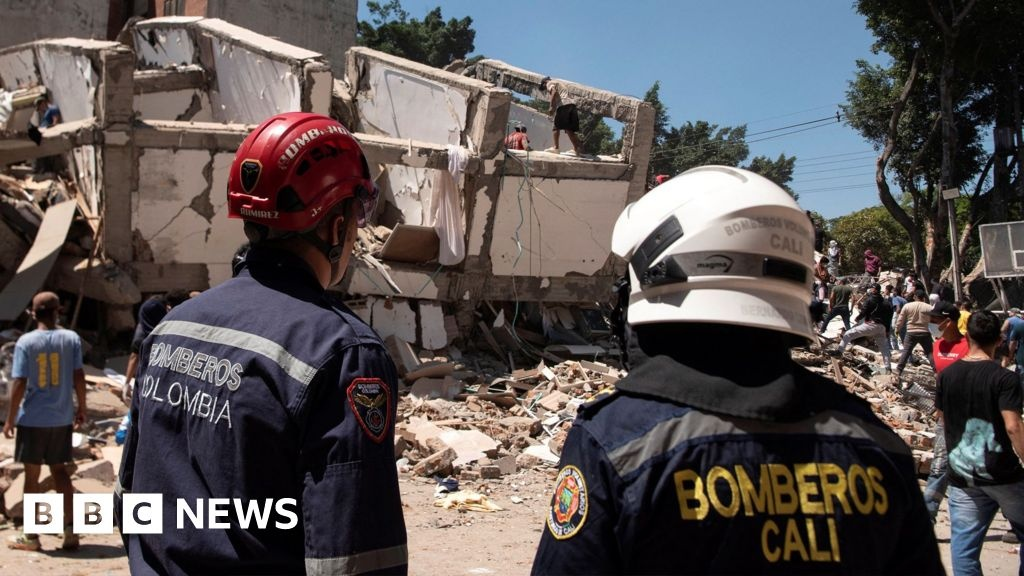
At least 132 people were killed after a magnitude 7.4 earthquake struck Colombia at 07:34 on Monday in Chocó province, prompting President Abelardo de la Espriella to declare a national disaster situation and grant special powers to respond to the emergency. The quake, one of the country’s largest in years, struck at a depth of 103km (64 miles) near the village of San José del Palmar and was felt across western Colombia and as far away as Venezuela, Ecuador and Panama.
The death toll was expected to rise, with rescuers fearing more people remained trapped beneath collapsed buildings. More than 480 people were injured, while the president said more than 1,500 homes had been damaged.
Much of the devastation was concentrated in Pereira, in Colombia’s coffee-growing region, about 55km (34 miles) from the epicentre. Local authorities reported at least 40 people dead in the city’s metropolitan area, where 65 buildings collapsed and people were believed to be trapped in 15 of them.
Videos from Plaza Bolívar, Pereira’s main square, showed at least one building collapsing, sending debris and dust across the open space where many people had gathered. A curfew was imposed in parts of the city until 05:00 local time on Tuesday.
Other cities also suffered heavy damage. In Cali, about 160km south of Pereira and roughly 200km from the epicentre, 32 buildings collapsed, while deaths were also reported in Manizales, Quibdó and Medellín, as well as across the Chocó and Valle del Cauca regions.
At least two people were killed in Manizales. In contrast, the mayor of San José del Palmar, León Fabio Marín Moncada, said there had been no deaths or injuries near the epicentre, although roads in and out of the area were damaged.
Witnesses described scenes of panic as buildings shook. Dan Cutler, 29, from London, who is in Cali with his partner, said: “I’ve never experienced anything like it.” He said they ran outside in their pyjamas and found no major structural damage to their hotel, though cracks had appeared in the walls and paint and plaster had peeled away.
In Manizales, Angélica Ávila said cracks opened in hotel walls as the earthquake hit. “Everyone was screaming… I saw dust coming out of the neighbouring buildings, and bricks were falling off the walls,” she said.
Journalist and meteorologist Luis Felipe Molina, also in Manizales and about 150km from the epicentre, said strict seismic-resistant building rules helped his building withstand the shock. “I have 450 books and only a few were left standing on the shelves. You could hear glass breaking and people screaming,” he said, calling it “a terrible and terrifying experience”.
The country’s aviation authority reported damage at regional airports in Pereira, Manizales, Quibdó, Armenia, Cartago and Buenaventura. In the capital, Bogotá, trees and traffic lights shook violently and cracks were reported in buildings, but there was no indication of serious damage to the city’s infrastructure.
International support began to gather as the scale of the disaster emerged. US Secretary of State Marco Rubio said Washington was closely monitoring the situation and stood ready to help, while Ursula von der Leyen said the EU’s Copernicus satellite system was being used in rescue efforts; Nayib Bukele of El Salvador also offered personnel and equipment.
The earthquake came less than two months after twin quakes devastated northern Venezuela, killing more than 6,300 people. The US Geological Survey said an estimated 1.5 million people felt shaking close to magnitude seven, adding that deep earthquakes are usually less dangerous than shallow ones, but can still release energy capable of causing major structural damage and potentially stronger aftershocks.