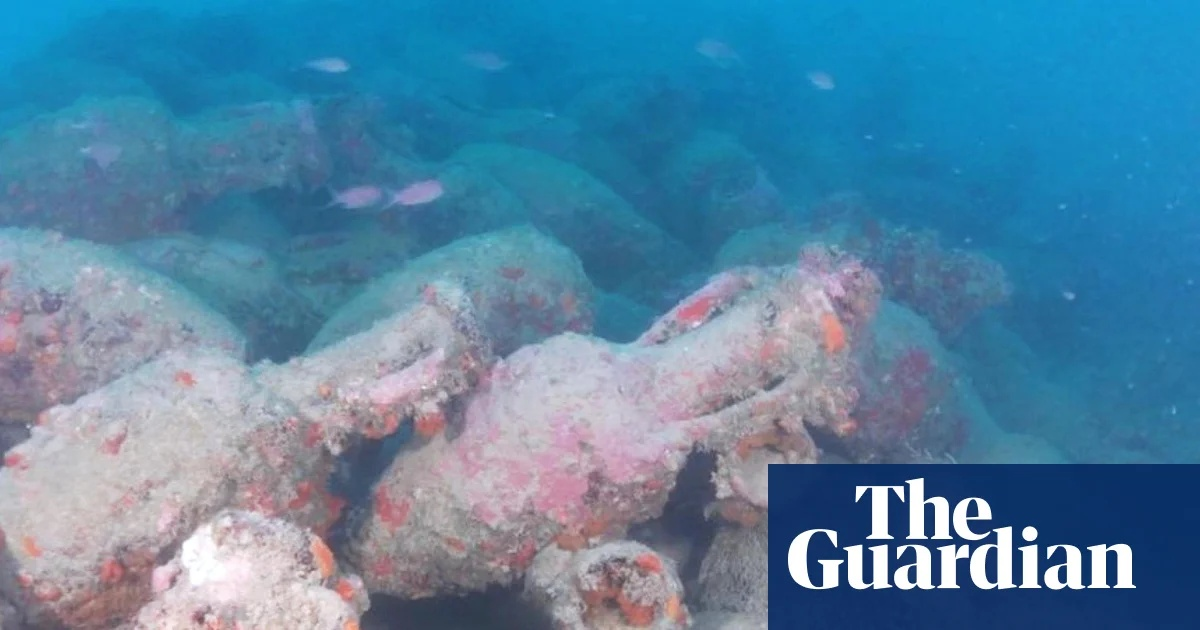
A 2,100-year-old Roman shipwreck carrying about 500 amphorae has been discovered 3 miles off the coast of Mazara del Vallo in Sicily, in what Italian officials have described as one of the most significant underwater archaeological finds in recent years.
Italy’s Carabinieri cultural heritage protection squad investigated the wreck after receiving a tip-off from fishers, using divers and underwater cameras to examine the site. The vessel was found at a depth of about 46 metres (151ft) and was carrying hundreds of amphorae, ancient two-handled ceramic jars with a narrow neck believed to have been used mainly to transport wine.
The wreck measures about 21 metres long and 6 metres wide. Italy’s culture minister, Alessandro Giuli, called it “one of the most important underwater archaeological discoveries of recent years” and said it offered “precious fragments of our history”.
Giuli said the find provided further evidence of the trade routes and exchanges that made the Mediterranean “a crossroads of civilisations”. Archaeologists believe the cargo can shed new light on ancient commercial links across the region.
Divers Giacomo De Mola and Igor Bisulli described the moment they came across the wreck. “Visibility wasn’t the best … I got closer. And my heart stopped. Below me was a vast expanse of amphorae,” De Mola said in an Instagram post accompanying video footage of the discovery.
He added: “This is, without a doubt, the most incredible discovery of my life.” De Mola said it was hard to describe the feeling of being among the first humans in nearly 20 centuries to see the site again.
Most of the ship’s cargo consisted of Dressel 1A amphorae, which were widely used to transport wine. Archaeologists consider them especially valuable because they can help reconstruct the commercial networks linking Italy with other parts of the Mediterranean between the second and first centuries BC.
Over the coming months, Sicily’s superintendency of the sea is expected to begin a new phase of scientific documentation and research at the site. Archaeologists will try to establish more precisely the date of the wreck, the origin and intended destination of its cargo, and the condition of the surviving material, while also preparing measures to protect what officials have called a site of exceptional archaeological significance.
The discovery is the latest in a series of important Roman wrecks found in Italian waters. In 2021, another Roman vessel dating from the second century BC was discovered off the coast of Palermo, lying 92 metres beneath the sea near Isola delle Femmine and carrying a large cargo of wine amphorae.
Before that, an almost intact Roman vessel from the second century BC was found in 2013 off the coast of Liguria. That ship, carrying about 50 valuable amphorae, was located by police divers about a mile off Alassio at a depth of about 50 metres, after a year-long investigation into artefacts believed to have been looted and sold on the black market in northern Italy.
Italian police recover hundreds of illegally removed ancient Roman amphorae each year, many of them from the homes or warehouses of collectors and art dealers. The waters around Sicily are regarded as one of the Mediterranean’s richest areas for underwater archaeology because the island sat on ancient maritime routes linking Greece, the Middle East, north Africa and Europe.